

Rational combi oven fault codes explained, CPC, SCC and iCombi Pro. Which codes can you clear yourself, which need a tech, and Melbourne repair costs?
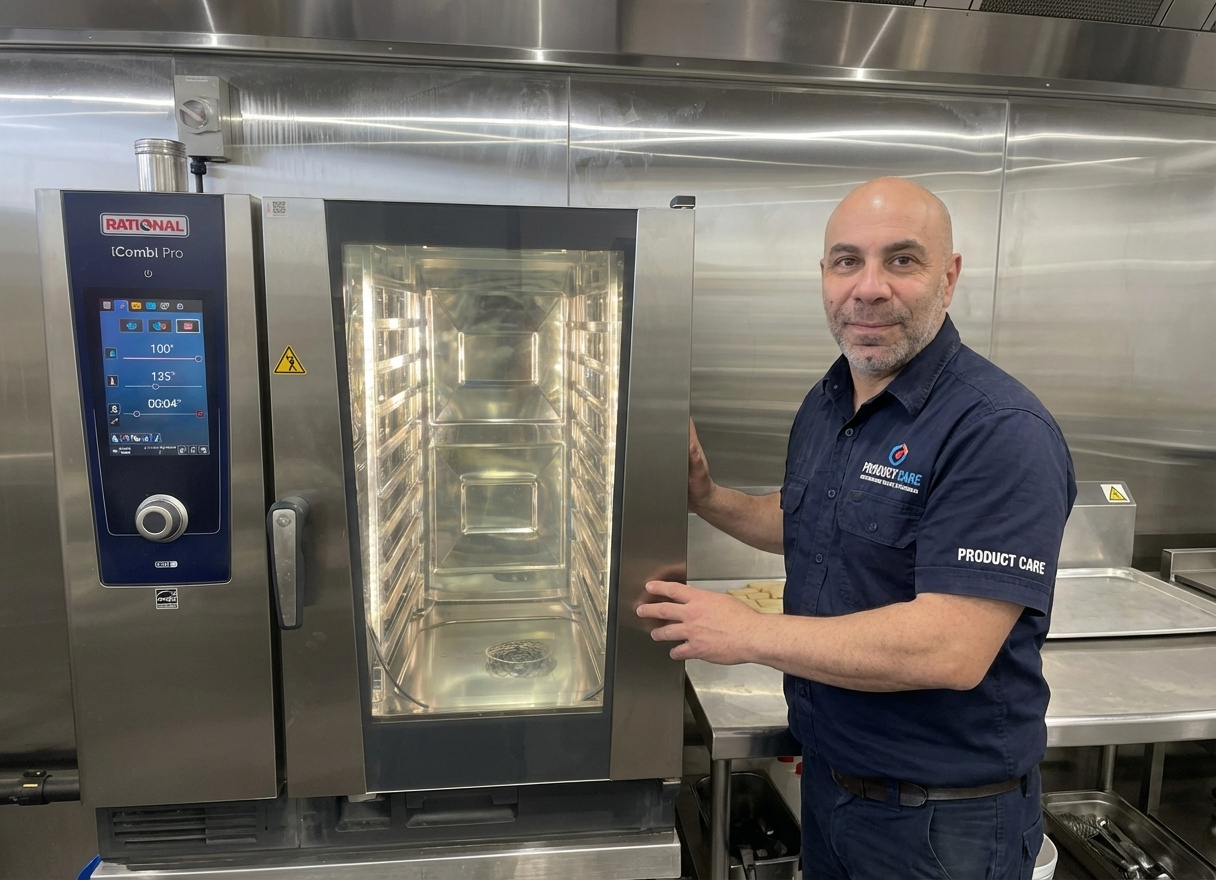
If your Rational is showing a fault code during prep or mid-service, the first useful thing to know is this. Rational fault codes fall into three categories. Codes you can clear yourself in under five minutes. Codes that let the oven keep cooking until a technician arrives. And codes that lock the unit down completely. Working out which category you’re looking at tells you whether to keep going, book a tech for tomorrow, or stop and ring one now.
This guide covers the fault codes across the main Rational combi oven generations, CPC, SelfCookingCenter (SCC), white efficiency, and the iCombi Pro, what each means in practice, what’s usually behind it, and what to do before you make the call.
Which Rational model are you looking at?
The fault code system is different across generations, and that matters because the same number can mean two different things depending on which oven you’ve got.
The CPC (Combi Steamer with ClimaPlus Control) was the workhorse from the late 1990s through the mid-2000s. Plenty of these are still in commercial kitchens across Melbourne, older bakeries, hotels with kitchens that weren’t refurbished in the last decade, that sort of site. CPC fault messages are mostly text, Abort, Rinse Start, Service 1, Service 3, with a few numbered Service codes.
The SelfCookingCenter (SCC), also branded whitefficiency, ran from around 2004 through to the iCombi Pro launch. Most commercial sites in Melbourne running a Rational today are on SCC. These use the Service [number] codes, Service 10 through Service 120, plus a separate set of E codes on the Combi Master variant.
The iCombi Pro replaced the SCC in 2020. The fault system carries forward most of the SCC logic, but with cleaner descriptions on the colour touchscreen.
Unsure which generation you have? Check the panel. Knobs with a small backlit display, CPC. Larger LCD with knobs, SCC. Full-width colour touchscreen, iCombi.
Rational fault codes you can clear yourself
Some codes don’t need a technician. They mean something interrupted a cycle, and the oven needs you to tell it that the situation is resolved.
| Abort (CPC) | Appears when CleanJet has been interrupted. Check that the rotating CleanJet arm is properly seated, the chemical containers have enough detergent and rinse aid, and the door is fully closed. Press Start, let it run a 4-minute rinse. If Abort doesn’t clear, it’s no longer a user fix. |
| Rinse Start (CPC) | Same triage. Arm seated, chemicals full, door closed, press Start for a 4-minute rinse. If Service 5 appears after several attempts, move to the next code. |
| Service 5 (CPC) | The CleanJet rinse program didn’t complete. Most often, the rinse container ran out. Top it up, then clear the code: close the cabinet door, then press the cabinet temperature key, the timer, and the IQT program key simultaneously. If Service 5 reappears after that, the CleanJet system needs proper maintenance. |
| Service 6 (CPC) | Also, CleanJet related. Rinse the cabinet thoroughly with the hand shower, close the door, then press the same three-key combination as Service 5. If it doesn’t clear, that’s a service call. |
| RESET (CPC) / rES (CM) | Almost always a gas issue. Check that the gas shut-off valve is open. Check that the venting hood is on and working. Check that no other gas equipment in the kitchen is creating a pressure drop. If you’ve got a power plug with reversible polarity and the unit was recently moved or rewired, reversing the polarity sometimes clears it. If none of that works, ring a technician. |
A note on the Service 5 button combination: it works because the CPC was designed to let kitchen staff clear minor CleanJet interruptions without waiting for a tech. The combination is deliberately obscure, so it doesn’t get pressed accidentally. Worth knowing if you’ve got an older Rational still in regular use.
Codes that mean “keep cooking, book a tech”
Some Rational fault codes don’t stop you from working. They flag that something needs maintenance, but won’t lock the unit down. The temptation is to ignore them. Don’t.
| Service 1 (CPC) | Steam generator maintenance needed. After a 2-minute wait, full operations, including IQT and Program Start, come back. |
| Service 3 (CPC) | The IQT sensor needs attention. IQT programs won’t run at full performance. Manual cooking still works. Book a service. |
| Service 4 (CPC) | Also, the IQT sensor is more serious. IQT programs and any manual program using the core probe are out of action. Manual programs without the probe still work. Book sooner rather than later. |
| Service 28 (SCC) | The steam generator B5 thermocouple is reading above 180°C. The indicator clears once it cools below 110°C. If you’re seeing this repeatedly, the issue isn’t transient; book a tech to look at the thermocouple position or insulation. |
| Service 29 (SCC) | PCB temperature is above 85°C. The control board is overheating. Check the air filter first; a blocked filter accounts for a large portion of these. Also check the cooling fan, control panel gasket, and whether the oven’s been installed somewhere with poor airflow or too close to another heat source. If the filter is clean and the issue persists, that’s a tech call. |
The pattern across these codes is the same. The oven is telling you a component is degrading. Pushing through with a Service 1 or Service 28 over months usually leads to a harder failure that costs more to repair than the original maintenance would have.
Codes that lock the unit down
These are the ones that stop production. Most need a technician.
| Buzzer sounds intermittent (CPC) | General maintenance, urgent. Unit out of function. Service call. |
| Service 11 (SCC) | The CDS sensor is sending too many pulses. Usually, a leak in the level electrode or water path to the steam generator. |
| Service 12 (SCC) | CDS sensor not signalling. Often, a blocked sensor or low water pressure. Check the water supply pressure at the inlet first; if pressure is at spec, it’s a sensor or wiring issue. |
| Service 13 (SCC) | The steam generator isn’t refilling during steam mode. The level electrode signal issue with the PCB. |
| Service 14 (SCC) | The level electrode isn’t recognising water. Almost always a water conductivity issue, where the water is too pure, often because reverse osmosis is in line without conditioning. We see this on Melbourne sites with high-spec water filtration upstream. A tech needs to confirm, but the fix is usually a water treatment adjustment, not a part. |
| Service 20.x (SCC) | Defective thermocouple. The number after the decimal tells the technician which probe (B1 cabinet, B2 quenching, B4 humidity, B5 steam generator). A faulty thermocouple is a replace-on-site job. |
| Service 23 / Service 24 (SCC) | SSR (solid state relay), short circuit, steam or hot air. Electrical fault. |
| Service 25 (SCC) | Improper water flow during CleanJet. One of the most common codes across Melbourne sites. Could be water pressure, the moistening valve, the nozzle, or the CDS sensor. Worth checking the inlet pressure first before booking. If pressure’s at spec, it’s a tech call. |
| Service 26 / Service 27 (SCC) | Drain valve faults. 26 is a permanently closed drain valve (replace assembly). 27 is a drain valve that won’t close during initialisation. Start the rinse/abort program first; if it persists, the assembly needs replacing. |
| Service 31.x (SCC) | Faulty core probe. The decimal indicates which probe element failed. Probes can be repaired or replaced depending on which element is gone. |
The CleanJet and Care codes, by far the most common
If you’re going to see one category of Rational fault code more than any other, it’s the CleanJet and Care family. A large portion of the Rational fault callouts we see across Melbourne commercial kitchens are cleaning-cycle related.
The codes to know:
| Service 5 (CPC) and Service 25 (SCC) | CleanJet cycle didn’t complete. |
| Service 40 (SCC) | Care pump issue or not enough Care solution reaching the steam generator. Check the hose from the Care pump outlet for kinks. Reset by completing a successful rinse program. |
| Service 41 (SCC) | Solenoid valve Y3, moistening valve, or CDS sensor problem. Resolve and reset with a successful rinse. |
| Service 42 (SCC) | Solenoid Y4 Care, hose blockage, or CDS issue. Same reset path. |
| Service 43 (SCC) | Solenoid Y1, Y3, or Y4 is passing water when it shouldn’t. Reset by completing an abort program. |
| Service 44 (SCC) | Steam not heating during CleanJet+Care. Abort program to reset. |
A few things worth knowing about these. The reason CleanJet codes dominate isn’t the cleaning system itself; it’s that the cleaning cycle stresses every part of the water and steam path at once. So a marginal moistening valve or a CDS sensor with scale on it will pass during normal cooking and fail during CleanJet. Treat repeated CleanJet codes as a signal that the broader water system needs attention, not just one part.
Water quality matters more on Rationals than on most commercial ovens. Melbourne mains is mid-range hardness on average, but commercial sites with combi ovens often share a softener with dishwashers, and a softener running on regenerated salt cycles puts conductivity into territory the Rational level electrode struggles with. Service 14 and recurring CleanJet codes often trace back to this.
Gas-specific Rational fault codes
Gas Rational ovens have a few codes that don’t appear on electric units.
| RESET (CPC) / rES (CM) | Covered above. Gas supply and venting first. |
| Service 32 (SCC) and Service 33 (SCC) | Faulty ignition box. The number after the decimal indicates which one (top, bottom for floor models, or both). 32 means change the ignition box at the location indicated. 33 means check ignition wiring, the gas valve, and the supply before assuming the ignition box itself has failed. |
| Service 60 (SCC) | Incorrect ignition box initialisation. Check gas settings, switch the unit off and on, then run the SD Repair program before assuming a hardware failure. |
Gas faults are not user repairs. If a Rational gas oven is showing any of these, and basic supply and venting checks come back clean, it’s a licensed tech call. Working on gas commercial cookers without a gas fitting license is illegal in Victoria.
What a Rational service call costs in Melbourne
Rough guide figures only, actual quotes depend on the site, the access, and what gets found once a tech is on the oven.
Standard call-out and diagnosis: a couple of hundred dollars during weekday business hours. After-hours and weekend rates run noticeably higher |
CleanJet maintenance and parts: a few hundred up to the mid-hundreds, depending on what’s being replaced (CDS sensor, moistening valve, hoses). |
Thermocouple replacement (B1, B2, B4, B5): mid-hundreds fitted, depending on which probe and how accessible it is |
Core probe replacement: mid-hundreds to high-hundreds, depending on whether it’s the whole probe or just an element. |
SSR replacement: mid-hundreds fitted. |
Steam generator descale and service: mid-hundreds to high-hundreds depending on scale build-up. |
Drain valve assembly: mid-hundreds fitted. |
Ignition box (gas): high hundreds to low four-figures fitted per box. |
These ballparks assume genuine Rational parts and a qualified Rational service technician. Cheaper quotes are usually either non-OEM parts or a non-accredited tech, which can save money short-term but voids any remaining Rational warranty and often returns the unit to fault within months.
When to call versus when to clear and keep cooking
The decision logic is simpler than it looks. If the code lets you clear it with a button combination or a rinse cycle and it doesn’t come back, keep cooking. Note it in the maintenance log and watch for recurrence. Two or three returns of the same code inside a fortnight means it’s a real fault wearing in.
If the code is in the “keep working, book a tech” category, book the service the same day, ideally for the next morning. The oven runs. The fault is real. Waiting weeks turns a mid-hundreds thermocouple job into a four-figure steam generator job.
If the code locks the unit and you’ve ruled out water pressure, gas supply, or the door not closing, stop. Don’t try to fault-find further. Some of these codes, Service 23 and Service 24 in particular, indicate electrical faults that can damage other components if power is cycled repeatedly.
Stuck on a Rational fault code?
If a Rational fault code is locking your oven down and you’ve already worked through the basics, contact us. We service Rational combi ovens, CPC, SCC, and iCombi Pro, across Melbourne commercial kitchens, gas and electric.
FAQs
Q1 – Why does my Rational Service 5 keep coming back after I clear it?
The clear sequence acknowledges the fault but doesn’t fix the underlying cause. Service 5 means the CleanJet rinse didn’t complete, usually because rinse aid ran out, the CleanJet arm wasn’t seated, or there’s a water flow issue during the rinse cycle. If rinse aid is full and the arm is correctly inserted, and the code returns within a cycle or two, the CleanJet system needs proper diagnosis. Common culprits are a partially blocked moistening valve, a worn CDS sensor, or scale build-up in the water lines.
Q2 – Can I keep using my Rational with a Service 3 displayed?
Yes, for manual cooking. The 2-minute wait clears, and the oven returns to full normal operation. IQT programs won’t run at full performance, though, so any preset using the IQT sensor will need to be replaced with manual cooking until the sensor is serviced. Book a tech within the week. Service 3 sensor faults tend to escalate to Service 4 if left, and Service 4 takes the core probe out of action entirely.
Q3 – How much does a Rational service call cost in Melbourne?
Weekday business hours for diagnosis are a couple of hundred dollars plus parts. After-hours and weekend call-outs are higher. Full repair cost depends on what’s needed; most common repairs land somewhere in the mid-hundreds to high-hundreds range, all up. Cleaning-cycle related faults at the lower end, sealed-system and ignition issues at the upper end.
Q4 – Is it worth repairing an older Rational CPC?
Depends on the fault and the age. A CPC with a clear single fault (failed thermocouple, drain valve, IQT sensor) is usually worth repairing; parts are still available, the ovens are robustly built, and a working CPC is still a capable combi oven. A CPC with a steam generator failure, multiple compounding faults, or a control board issue may not be, the parts cost approaches what a used SCC would set you back. Rule of thumb: if the repair is under about 30% of the replacement cost and the rest of the oven is in reasonable condition, repair. Over 50%, look at replacement.
Q5 – What’s a Rational “rinse” and why does it keep failing?
The CleanJet cleaning cycle on a Rational runs a rinse phase to clear detergent residue. The “rinse” the fault codes refer to is this part of the cycle, not the cleaning itself. Most rinse failures come from rinse aid running out (the most common), the rinse nozzle being blocked, water pressure dropping during the cycle, or a CDS sensor that’s lost calibration. Worth checking the rinse aid container before assuming the worst.
Q6 – Do I need a Rational-accredited technician?
For warranty work, yes. For out-of-warranty repairs, a qualified commercial appliance technician with Rational experience can do most jobs. The exceptions are gas work (must be a licensed gas fitter in Victoria) and any work needing Rational diagnostic software access. For complex faults or anything involving the control board or steam generator, Rational-accredited is usually worth the cost; the diagnostic time alone justifies it.

Dishwasher Repair That Saves Melbourne Kitchens
Putting off a dishwasher repair is one of those decisions that feels harmless at the time and expensive later. A machine that is draining slowly,
What to Do When Your Washing Machine Repair Just Can’t Wait
An urgent washing machine repair has a way of arriving at the worst possible moment, usually with a full drum of soaking clothes and a

The Appliance Repair Checklist Every Busy Household Should Keep Handy
The best time to think about appliance repair is not the morning your fridge stops cooling or your washer floods the laundry. It is now,
Appliance Installation Tips That Make Your New Appliance Feel Right at Home
Getting the appliance installation right is what stands between a new machine that just works and one that rattles, leaks, or trips the power on
The Secret Life of Broken Ovens: Appliance Repair in Melbourne That Saves Dinner
When your oven dies an hour before guests arrive, appliance repair in Melbourne suddenly stops feeling like a chore and starts feeling like a rescue
The Weirdly Important World of Appliance Parts and Why They Matter
Most of us never think about appliance parts until something stops working, and that is exactly when they suddenly become the most important thing in